
Experiment in Progress
Why write about my quest to earn a PhD?

I’ve never truly appreciated writing until the past year or so.
I always thought it was something you did to check off a box, turn an assignment in, and forget about. That was how I approached writing in high school and, largely, how I approached writing through the first half of my undergrad.
During my first year of college, I tried to journal regularly for the first time. I enjoyed writing out my day on a sheet of paper. My grammar didn’t matter, and I could spell words as creatively as the ink would allow. As happens with New Year’s resolutions and beginning-of-semester plans, the first few weeks started great. I consistently wrote for 15 or so minutes before going to sleep at a reasonable hour. Quickly, though, as assignments began to accumulate and exams were around the bend, I had to cut out everything ‘unnecessary’ wherever I could to be sure I finished everything that had to get done. Alas, journaling went out the window around the same time as my strict bedtime. I tried to start journaling a few more times. Although some of my attempts were better than others, they all seemed to dry up as the semesters intensified.
Personal writing had become a chore, while school/work-related writing remained a burden.
Yet, beckoned by my desire to get good grades and a mild case of perfectionism, I continued to write when my assignments called for it. Even though I tried to plan out my essays ahead of time, I always pushed the writing part off until later. I would plan the theory of what I wanted to say (an important step, to be sure) but then get stressed about finding the perfect way to translate that jumble of thoughts into a flowing story. Having plenty of other homework and club obligations to fill my time with, writing quickly fell through the cracks. In this procrastinated state, I naturally became rushed in my writing. Once, at the end of my first year, I pulled two semi-all-nighters in a row because I had so much left to write. This was a common theme with every writing assignment I had in the first half of my undergrad. I’m not exactly sure why I procrastinated writing so much. Why did writing stress me out, but solving chemistry problems make me smile?
Remembering those days when I lived in a dorm, surrounded by thousands of other students working their hardest, not taking breaks, and doing everything right the first time, it’s easy to understand why I was stressed. If everyone else could work so hard, why couldn’t I? “It must be because I’m not good at it,” I probably thought. Other ideas, including “I’m just not a good student” or “I’m probably not smart enough,” banged around in my skull until the semesters ended and I could leave the situation.
Eventually, though, once I moved away from campus, literally separating my home and my work, everything started to become clear.
Of course, I wasn’t actually surrounded by thousands of robot-like students manufacturing success without breaking a sweat. I had somehow come up with the idea that everyone around me was living a perfect life when that could not be further from the truth. It wasn’t until I took a step back (and until relaxed COVID-19 policies allowed me to meet people) that I realized everyone else was just like me. I was surrounded by real people who made mistakes and who were also bad at things but who, nonetheless, were motivated to get better.
But those stressed-out nights when all the dorm windows glowed against the night sky (obviously because their inhabitants were studying), the stress of not being good enough at something made me afraid to do it. I disliked writing because it reminded me of how insufficient I was. It never came naturally to me because there was something wrong with me.
Alongside this stress, I also did not enjoy writing because nothing motivated me to write. I wrote out of necessity, not because I had anything meaningful to share. And without that motivation, there was no way my blank Microsoft Word documents would magically fill themselves with text.
\/\/\/\/\
Ok, but clearly, you’re reading my writing today. So, something must have changed, right?
To be completely honest, I’m not entirely sure. But I think so? My writing style is certainly similar. I definitely do enjoy writing now—or, at least, I appreciate it more than I did back then. How that came to be is definitely still a bit blurry, but I’ll do my best to turn it into an organized story.
\/\/\/\/\
Along with contributing to my decision to ditch the pre-med track for a career in basic science, the course Bioorganic Chemistry I took during the fall of my junior year played a crucial role in my unconscious quest to appreciate writing. I absolutely loved this class. I loved the content. I loved the teaching. And I adored the final paper. Finally, a writing assignment I was actually motivated about!
I was assigned to write a review article about a particular antibiotic of interest. I chose to write about the molecule abyssomicin C. I’ll spare you the chemical details. Still, for context, this antibiotic is produced by a bacterium that literally lives in the abyss at the bottom of the Sea of Japan. Abyssomicin C itself even looks like a sea creature of some sort!
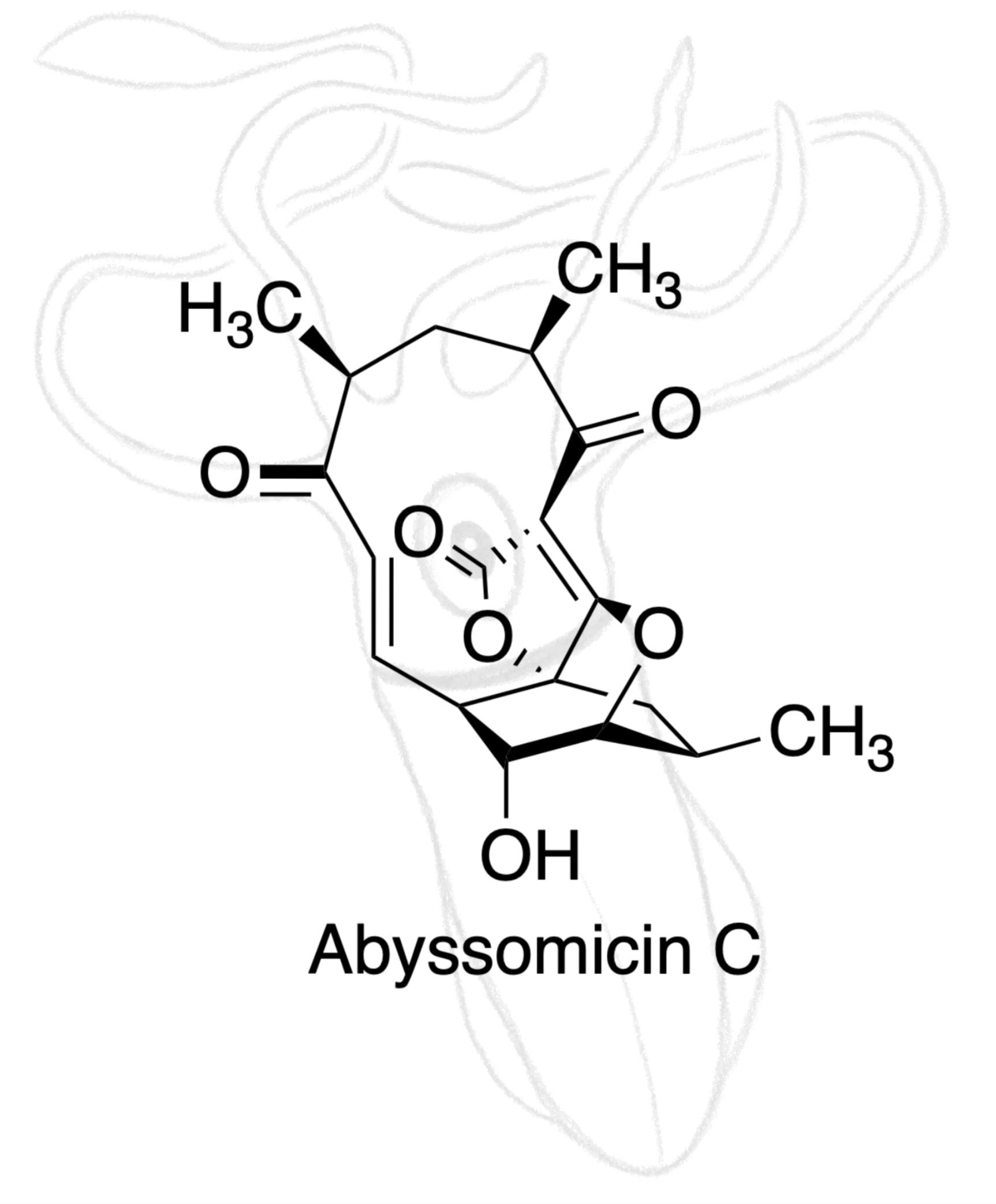
As I read more and more papers, I found that Abyssomicin C had a fascinating story, and I was excited to chronicle its discovery in my paper. Along the way, the feedback I received from my instructor (who, notably, was also my research advisor) was incredibly useful and encouraging. I felt competent as a writer, at least enough to keep going, and I was passionate about telling the story of the “antibacterial Kraken.” I finished writing the paper, translated it into an oral presentation, and celebrated!
You probably noticed that I didn’t mention procrastination at all with this paper. Writing this paper gave me a reason to get better at writing. I wanted to share complex scientific ideas in an accessible way to improve my communication within the scientific community and better inform those without a background in the natural sciences. Even though I knew such writing had never come naturally to me before, I finally realized that all I needed was practice.
I continued to attack the rest of my scientific writing with excitement. I began to improve in both the speed at which I could write and the cohesion of my thoughts. Remember that paper I lost a lot of sleep for my first year? When I finished it and hurriedly turned it in, I ended up with a 46-page monster. By no means did that report have to be 46 pages. I could do it in 20 or even less if I re-wrote it today.
Of course, just because I’ve gotten better doesn’t mean I don’t have anywhere to improve. In fact, I would say I just started to climb this mountain. Concisely writing complex ideas is an art and is something I am not great at. But it’s an area I am actively trying to grow in.
That’s the goal of this webpage/blog/newsletter/collection-of-thoughts.
I’m starting my PhD in less than a month, and I want to document that journey. I want to write through that journey to become better at understanding myself and better at communicating both scientific and nonscientific topics alike.
And I’m not going to let it become a chore. Writing here is going to be something I choose to do because it brings me joy. There will be no schedule: I’ll write when I have the time. I’ll write when I feel something I experienced or have thought about is worth sharing.
Grad school is going to be about trying many different things and failing. And trying to understand a bunch of other things and failing. And failing again. And failing a little more. But with each failure, I’ll try to fail more gracefully and try to learn something new along the way.
So why not kick off that spirit of growth-through-failure by starting (and likely failing) something new: The Lab Notebook.
When running an experiment, you document everything you do in your lab notebook. Every tiny drop of every clear (or fun-colored) liquid you add to your test tube or reaction flask goes in that book. The ordinary, the exciting, the good, the bad, and the random. It all goes in there to serve as a record of what happened to help you understand an unexpected result, troubleshoot a problem, or serve as documentation for someone else to reproduce your method.
That’s my goal with this webpage/blog/newsletter/collection-of-thoughts/assortment-of-failures: to reflect on my PhD as I’m going through the process, always with a growth mindset.
So, if you have the time to read my posts, please…
Make yourself comfortable.
Take off your lab coat.
Brew a cup of tea.
Put on some smooth jazz.
And embark with me on the journey to add 3 letters and a comma to my name!
Love it! Great post.
I love your growth mindset! And I look forward to read your musings in the years to come!